
Small kitchens can work beautifully when every centimetre is planned with purpose, and many kitchen renovations in Tamworth are really about making the existing space function better rather than trying to create more of it. Pulse Kitchens sees time and again that the best results come from careful layout planning, smarter storage and design choices that improve how the kitchen feels to use every day. This article explores how to rethink layout for smoother movement, reconfigure cabinetry for smarter storage and introduce tailored solutions that keep everyday essentials exactly where they are needed. Readers will discover how considered design choices can transform a cramped kitchen into a highly functional hub that feels larger, lighter and easier to use.
Across the sections that follow, the article looks at how to assess the current layout, identify bottlenecks and choose a configuration that improves flow between cooking, preparation and cleaning zones. It also examines practical storage strategies, including vertical storage, integrated appliances, corner solutions and custom inserts that reduce clutter on benchtops. Along the way, it highlights the role of lighting and finishes in making a compact space feel open and well organised. By the end, readers will understand the key decisions that improve storage and movement in a small kitchen so they can approach their renovation with more clarity and confidence.
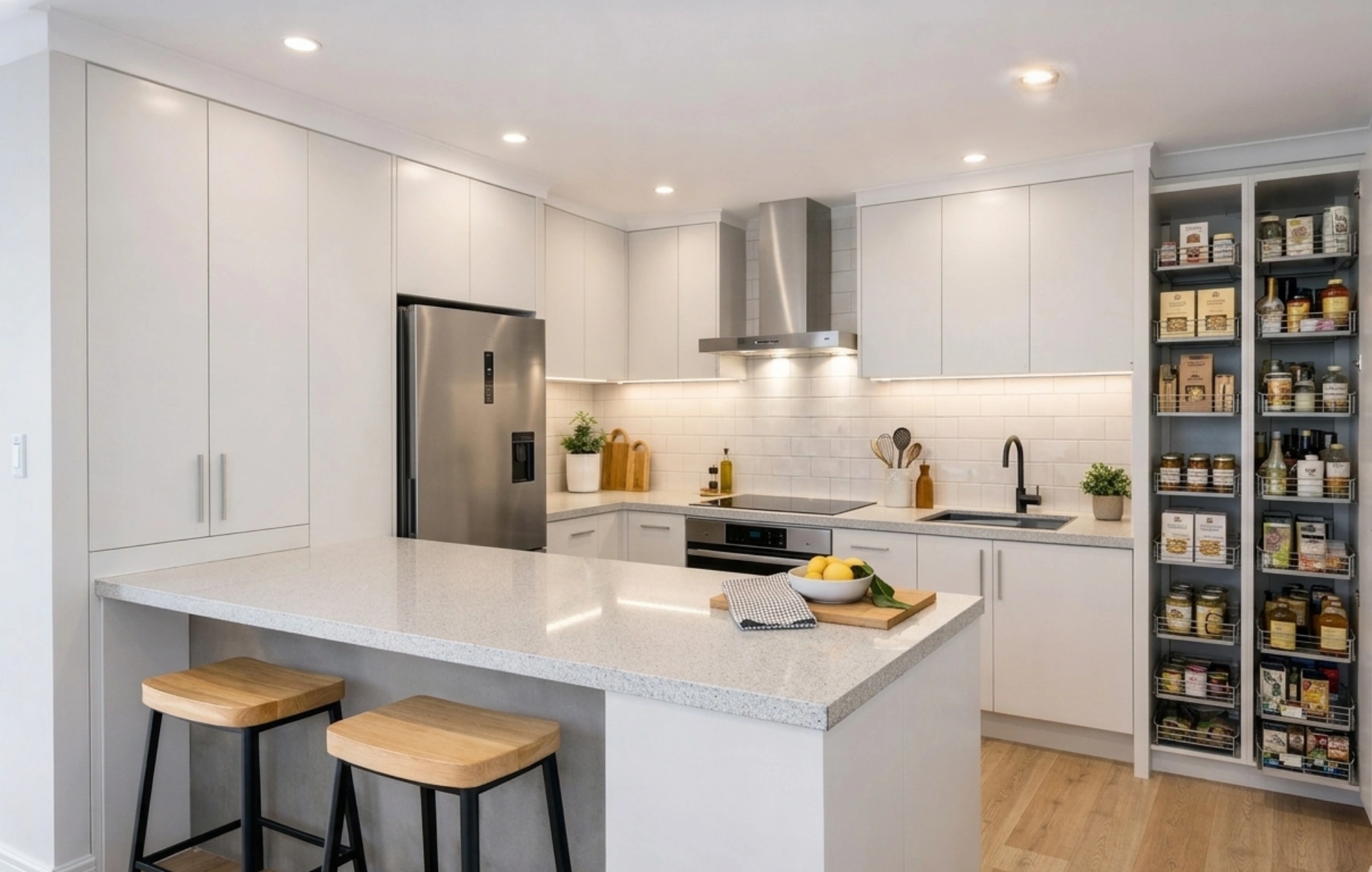
The right layout is one of the biggest factors in how well a small kitchen works day to day. Before choosing colours or finishes, it helps to decide how the key elements will fit within the space: where to prep, cook, clean and store. A smart layout reduces unnecessary steps, opens up tight areas and creates clearer paths so more than one person can move around without constantly getting in each other’s way.
In a compact room, not every popular layout will suit. Existing windows, doors and service locations often shape what is realistic. A practical starting point is to map the main work zones around the sink, hob and fridge so they support an efficient workflow, whether that takes the form of a working triangle or a more linear work corridor, then build storage and appliances around that.
For very small kitchens or open-plan spaces, a single-wall layout can be one of the most efficient options. All units run along one wall, with the fridge, sink and hob arranged in a logical sequence. Placing the sink near the centre with at least one usable stretch of worktop on either side helps prevent the prep area from feeling too restricted. Tall pantry units can sit at one end to keep the middle of the kitchen visually lighter and less bulky.
Where there is room for two facing runs, a galley layout often offers the best balance of storage and flow in a small footprint. To keep movement comfortable, the gap between the two runs should generally be at least 900 mm, with around 1,000 mm to 1,200 mm often working better where space allows. One side can serve as the main prep and cooking run with the hob and ovens, while the opposite side can be used for cleaning and storage with the sink, dishwasher and tall units. Positioning the fridge at the end of a run rather than the centre can also help prevent people crossing through the main cooking zone just to grab food.
An L-shaped layout works well in small kitchens that open into another room. By using two adjoining walls, it frees up floor space and keeps one side open for circulation or a small dining area. The hob often works best on the longer leg of the L, while the sink can sit on the shorter leg so the corner becomes useful prep space rather than a dead zone. Corner storage such as carousels or pull-out units is important here to avoid wasting space.
For those wanting maximum storage in a compact room, a U-shaped layout can also be highly effective. Three connected runs wrap around the cook, keeping everything within a small pivot. To keep it from feeling cramped, the opening of the U should usually be at least 1,000 mm wide, with more space preferable if more than one person will use the kitchen regularly.
In a small kitchen, an island is only practical if there is at least 900 mm of circulation space around it, although closer to 1,000 mm or more usually feels more comfortable. If that amount of clearance is not possible, a peninsula connected at one end is often the better option. Peninsulas can add valuable bench space and storage while also creating a natural divide between the kitchen and an adjoining dining or living area.
In many small kitchen renovations, peninsulas are used to provide breakfast seating on the outer side and storage or appliances on the kitchen side. Careful placement of the hob or sink on a peninsula can improve workflow, but in very tight rooms it is often more practical to keep plumbing and cooking appliances against the wall and use the peninsula mainly for preparation and serving.
In a small kitchen, every centimetre counts. Smart storage is less about adding more cupboards and more about using existing space in a more thoughtful way so that everything has a home and benchtops stay clear.
The aim is to keep what is used most often within easy reach and move occasional items to the edges of the room. This instantly improves how the kitchen feels to use and often means a smaller layout can work better than a larger but poorly planned one.
Most small kitchens have unused space above wall cabinets. Extending cabinetry to the ceiling creates valuable storage for rarely used appliances, platters and bulk pantry items. Taller wall units or a bulkhead with integrated cabinets can make better use of this space while also preventing dust from gathering on top.
Inside each cabinet, adjustable shelves allow the storage to be tailored to the items being kept there rather than wasting height with fixed shelf positions. Slimline cabinets can also be added beside fridges or along narrow walls to store trays, chopping boards and baking tins upright.
Open shelves can work well in tight spaces where cabinet doors would clash, provided they are used selectively and kept organised. They are best used for everyday dishes, glassware or canisters so these items stay accessible without crowding the benchtop.
The right internal fittings can easily double how much a cupboard holds and how usable it feels. Instead of relying on deep, dark cupboards, it often makes more sense to use:
Corner cabinets are notorious dead zones in small kitchens. Replacing simple shelves with a rotating carousel or pull-out corner system brings items to the front so space is not wasted at the back. Slim pull-outs besides the oven are perfect for oils, spices and trays and keep cooking essentials in one narrow yet efficient zone.
Clear bench space improves both storage and flow. To protect this space, a dedicated appliance garage can be included so the toaster and kettle can stay plugged in but hidden behind a roll-front or pocket door system.
Wall-mounted rails or magnetic strips keep utensils and knives off the bench without using a whole drawer. Under-cabinet hooks or narrow rails can hold mugs or frequently used tools, while undershelf baskets inside cabinets capture extra space for wrapping foils or small containers.
Improving workflow in a small kitchen starts with making every step as efficient as possible. The aim is to reduce unnecessary walking, turning and bending so cooking and cleaning feel smoother and less awkward. In practice, that means understanding how the space is actually used and shaping the layout, clearances and storage around those habits.
Good movement in a compact kitchen relies on clear paths, sensible positioning of key appliances and enough room for doors and drawers to open without clashes. With smart planning, a small kitchen can feel surprisingly open and easy to navigate.
The classic working triangle connects the fridge, sink and hob or cooktop. In a small kitchen, however, good workflow and sensible zoning often matter more than strict triangle geometry.
A practical way to approach this is to place the key elements like this:
In a galley kitchen the triangle becomes more like a line. Fridge, sink and hob should follow the order that cooking usually happens. For example, food comes from the fridge to the sink for rinsing, then to the prep area, then to the hob. Placing the oven under the hob or in a nearby tall unit keeps hot trays close to the cooking zone and out of main walkways.
Even in a tight footprint there must be space to move without bumping into corners or open doors. As a rule of thumb, there should be at least 900 mm between opposing runs in a galley or U-shaped layout, with around 1,000 mm to 1,100 mm often working better if two people will use the kitchen at the same time.
To maintain clear circulation:
If the kitchen opens into another room, keeping the main walkway free of tall cabinets helps the eye and the body move through without interruption. Corner solutions like L-shaped pull-outs or carousel units also prevent dead zones that force users to lean and twist into awkward gaps.
Zoning groups related tasks together so items are stored where they are used. This cuts down on backtracking and makes a small kitchen feel more intuitive.
Common zones include:
Deep drawers often work better than cupboards in these zones because the contents slide out to the user rather than forcing the user to reach into the space. Tall pull-out pantries near the prep zone put dry goods in easy reach while keeping floor space clear. Thoughtful zoning like this supports a natural workflow, so movement through the kitchen feels calm rather than crowded.
In a compact space, every visual choice affects how open or cramped the room feels. Thoughtful use of light, colour and storage can make a small kitchen look larger while also helping it function better day to day. When bulky elements, harsh contrasts and unnecessary visual breaks are reduced, the room tends to feel calmer and less cluttered.
The aim is to create a space that reads as more continuous and less broken up. Smart lighting, reflective finishes and a more streamlined layout can all help a small kitchen feel brighter, more open and more spacious.
Light and colour are the fastest way to change how big a kitchen feels without changing the walls. Lighter, low-contrast palettes often work well because dark or heavily patterned finishes can visually shrink a room.
White or soft neutral cabinetry with a similar tone on the splashback and walls helps everything blend together. If some contrast is preferred, keeping it subtle, such as a deeper tone on the floor and lighter tones on vertical surfaces, usually works best.
Lighting is just as important. Layering ceiling lighting with under-cabinet strips and sometimes plinth lighting at the kickboards can help the room feel brighter and more considered. Good task lighting over benchtops means the back of the kitchen is bright, which makes the room feel deeper. Where possible, it is best to avoid large solid shades that block light and use slimline or recessed fittings instead.
Clutter makes any kitchen feel smaller, so storage should be planned to keep surfaces as clear as possible. Full-height cabinetry that reaches the ceiling reduces the shadow line and gap where dust collects while also providing more enclosed storage. This makes it easier to keep toasters, small appliances and pantry items behind closed doors rather than out on the bench.
In small kitchens, too many short cabinets or large amounts of open shelving can create visual breaks and make the room feel busier. A more streamlined look often comes from using fewer, larger cabinet fronts with integrated organisation inside, such as pull-out pantries, inner drawers and corner storage solutions. Handles can also be kept slim or integrated so the cabinetry reads more like continuous surfaces and less like a busy grid.
On the benchtop, it helps to keep only a small number of everyday items on display. A rail or magnetic strip for knives, an integrated bin system and dedicated pantry storage for cereals and snacks can all help keep surfaces clear. Large-format splashback tiles can also reduce grout lines, which helps the wall feel more continuous and less visually crowded.
The shape and thickness of elements in a small kitchen can greatly affect how open it feels. Where the layout allows, long uninterrupted benchtop runs usually work better than lots of short sections and angles. This creates a stronger horizontal line, which can make the room appear wider.
Slimmer benchtops often help reinforce that effect. For example, a 20 mm top in a light stone or laminate can feel visually lighter than a 40 mm edge in a dark finish. End panels and pilasters can also be kept as minimal as possible so the kitchen does not feel weighed down by chunky vertical elements.
For seating at an island or breakfast bar, stools that tuck completely under the benchtop and have open frames help keep the floor area visually clear. Appliances can also be integrated behind panels or selected in matching finishes so they blend in rather than standing out as dark blocks.
Not every small kitchen needs walls knocked down or windows moved. However, there are times when rethinking the structure is the best way to gain proper storage, safer circulation and a layout that works far better day to day.
The key is to look beyond surface finishes and ask whether the room is simply too tight or poorly arranged for cabinetry alone to solve the problems. When that is the case, targeted structural changes can unlock far better storage and flow than endless compromises with the existing layout.
If people constantly bump into each other or appliances cannot open fully, the kitchen may be boxed in by walls that no longer suit modern living. Removing or partially opening a wall can:
If a wall is being removed or opened up, it is important to confirm whether it is load-bearing and ensure the opening is properly designed and supported. Sometimes a full removal is not necessary. A wide servery opening or a half‑height nib wall can keep some separation for storage or power points while still relieving the bottleneck.
In small kitchens a poorly placed doorway or window can block entire walls from being used for tall storage or continuous benchtops. Relocating or resizing these openings can transform what fits into the room.
Moving a doorway slightly can create an uninterrupted run of lower cabinets and overheads or allow a full‑height pantry where there was previously a circulation gap. Narrowing a door or changing a hinged door to a cavity slider can also free up wall space and reduce conflicts with appliance doors.
Windows are worth adjusting when the sill height or position prevents practical use of the wall. For example, raising a low window can allow continuous benchtop and splashback while still keeping natural light. Any changes to windows should balance the need for storage with ventilation and natural light so the kitchen does not feel dark or cramped after the alteration.
Sometimes plumbing and electrical points lock the layout into a bad arrangement. Shifting these services is a structural decision that can enable far better storage and workflow.
Moving the sink a short distance can centre it under a window and free up corner space for a blind corner solution or corner drawers. Relocating the cooktop can allow a run of deep drawers directly below and taller storage at the ends without clashing with safety clearances. Updating electrical circuits can support additional appliances in a dedicated pantry or appliance garage instead of spread across the benchtop.
Renovating a small kitchen for better storage and flow is not just about fitting more into less space. It is about improving how the room works for your daily life. With careful layout planning, intentional cabinet and drawer choices and smart use of vertical space, even compact kitchens can feel open, organised and efficient. Thoughtful decisions such as corner storage solutions, the right mix of drawers and cupboards, well-defined work zones and improved lighting help make everyday tasks easier. Adding details like slimline appliances, custom joinery and cohesive finishes ensures the space looks as good as it functions. When everything is designed around how you cook, entertain and move through your home, a small kitchen becomes a practical and enjoyable space that adds real value to your lifestyle.

